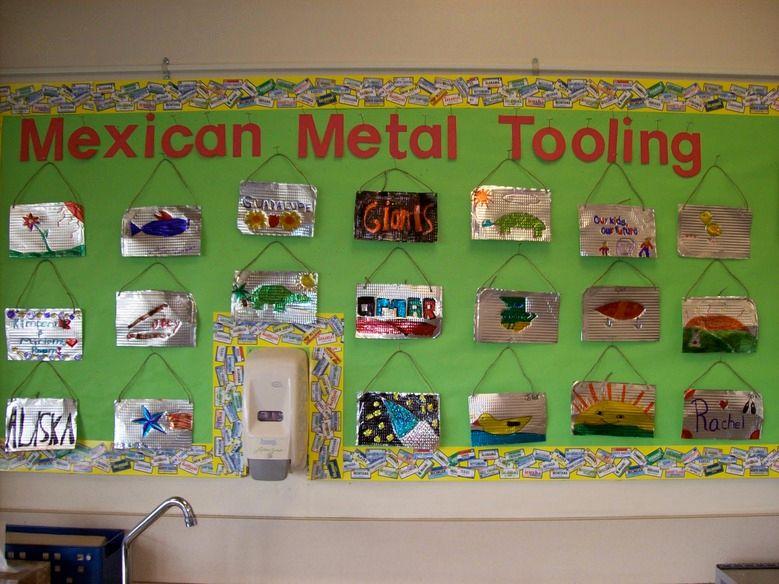
Mexican Metal Tooling Art Project
Classroom Background 4th/5th Grade Combination Class, with a total of 23 students. Half are Caucasian, half are Hispanic. There are two ELL students, and three GATE students.
Goals/Anticipated Outcomes The students will be introduced to folk art from around the world.
The students will learn about the historical connection between Mexico and the US through art.
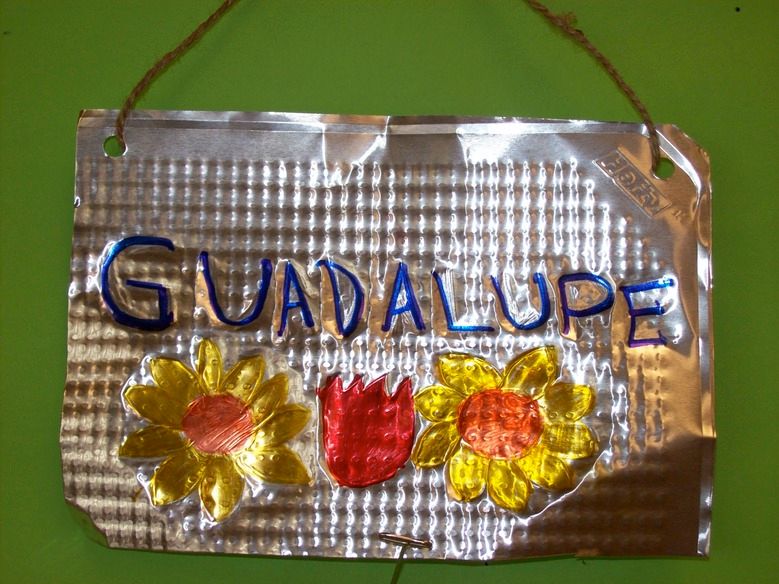
The students will create folk art from Mexico (Mexican metal tooling).
Materials 36 gauge aluminum-tooling foil, 4" X 4" Paper for rough draft, pencils, permanent markers, string,newspapers and magazines to place underneath the metal
Plan: Hook (Into) 1. Write "1848" on the board.
2. Any ideas about this number? Write students comments.
3. 1848 was the year CA (and other states: AZ, CO, UT, NM, NV, WY) went from being part of Mexico, to being part of the U.S.
4. Why?
5. Mexican-American War and the Treaty of Guadalupe Hildago.
6. This isn't a History lesson, though. Today we are going to do an art project. But I'm a strong believer that everything is connected: Art, History, Science, Math, etc.
Connections help us to remember things and become better thinkers.
7. Today, we are going to celebrate our nation's and state's connection with our neighbor to the south: Mexico.
Plan: Procedures (Through) We are going to create works of art via Mexican metal tooling.
Mexican metal tooling is a form of folk art.
Who can tell me what folk art is?
Read the definition, show pictures from the books, show the 3-d folk art I brought with me.
Here's an example of Mex. metal tooling.
Read, "Market Day" book
Why don't we brainstorm on some ideas of what you would like your image to be.
It needs to be bold & simple.
Go through directions that are written on an overhead transparency with the students.
I will demonstrate how to create the metal art, incorporating the instructions that are on the overhead.
Questions?
For transparency:
You Will Need: (see materials section)
Directions:
1. Decide on your design.
2. Draw design on your rough draft paper.
3. Make sure a stack of paper or a magazine is under your foil when tooling.
4. Either trace the design by putting the rough draft on top of the foil, or draw your design free hand with your pencil or tool.
5. Emboss by rubbing larger areas to make it pushed out on the other side.
6. Turn it over and emboss using the other side, also.
7. Color the metal by using permanent markers.
8. Hole punch on top two corners, thread the string, and tie the string in back.
Plan: Extensions (Beyond) The students can write a poem about their metal tooling work of art.
Plan Differentiation
Academically talented students could research the history of folk art from the country of their choice.
ELL Adaptations - I will check in with them more than the other students to check for understanding.
Special Learner Adaptations - Describe adaptations you will use for special learners.
Technology Opportunities - Internet research on folk art.
Assessment - I will monitor the students' progress by walking around the room. The assessment will be in the finished product of the Mexican metal tooling art work.
Resources| Local Traditions: Siesta and Arts & Crafts |
| This two-part program features on-location video in many parts of Mexico. Using a traditional storytelling style, an old citizen tells us about his beloved Mexico. "Part One: Mexico: The People and Their Land" teaches viewers about the location and geography of Mexico, its natural resources, industries, and form of government. We'll hear about the country's problems and the causes-an expanding population and limited employment opportunities-as well as the hopes and aspirations for Mexico's future. "Part Two: Mexico: The People and Their Customs" gives a brief history of Mexico and helps viewers understand the country's cultural diversity. We examine population, educational opportunities, and the rich heritage of individual artisans and we see and hear the people's music and festivals. Factors which unite the Mexican people - their religion, emphasis on family life and community activities - are revealed. |
|
|
Understanding the Historical Contributions and Cultural Dimensions of the Visual Arts: Students analyze the role and development of the visual arts in past and present cultures throughout the world, noting human diversity as it relates to the visual arts and artists. |
|
|
...Describe how art plays a role in reflecting life (e.g., in photography, quilts, architecture). |
|
|
...Identify and discuss the content of works of art in the past and present, focusing on the different cultures that have contributed to California's history and art heritage. |
|
|
|
|
|